Online fashion retail industry in India is facing strong competition, where customer choices change quickly and technology decides success. In this case study, we will explore everything you want to know about the Myntra business model. But before diving into how Myntra operates, let’s take a look at its roots—was the Myntra we know always the same in its early years?
Among many digital platforms, Myntra has built a successful business model that attracts a large base of Gen Z and young shoppers. The scale of the platform is clear from its numbers, with the Android app crossing 10 crore downloads and a big user base on iOS. A June 2026 Bank of America report said Myntra has more daily active users than its rivals, showing its strong position in the Indian market.
How Myntra Started
Myntra was founded in 2007 by Mukesh Bansal, Ashutosh Lawania, and Vineet Saxena. It did not begin as a fashion retail site. The original idea came from Mukesh Bansal in Silicon Valley, where he saw the fast growth of digital commerce. After returning to India, he saw a gap in the market for personalized items. So, the company started as a B2B gifting platform, making customized merchandise for corporates and individuals.
By 2011, the founders realized this gifting model could not grow big. They saw that lifestyle and clothing showrooms in malls had heavy costs but very few weekday customers. These stores carried large inventory but had weak sales cycles. To solve this, the management decided to shut down the gifting business and focus fully on branded apparel and lifestyle products—and this became the beginning of the new Myntra business model..
To gain trust quickly during this shift, Myntra changed its market strategy. It partnered with global sportswear brands like Nike, Reebok, Puma, and Adidas. A key move was getting digital rights to sell official IPL jerseys and Indian cricket team merchandise. The cricket craze helped Myntra build trust. Official brand partnerships turned Myntra from a simple website into a trusted fashion destination, changing how customers saw it.
Rapid commercial success of this strategy made the platform an attractive target for acquisition. In May 2014, Flipkart acquired Myntra in a deal valued at Rs 2,000 crore ($330 million). Despite the ownership change, the platform was maintained as a distinct and independent fashion entity.
Today, it operates as a premier digital destination for clothing, footwear, accessories, and cosmetics. While it operates under the broader umbrella of its parent organization, the platform maintains separate corporate execution, user interfaces, and brand partnerships to secure its unique identity.
Myntra Sale Calendar
While people shop heavily on the Myntra app throughout the year, the real USP of the Myntra business model is not just its routine sales, but special occasions when this fashion app offers massive discounts to its customers. The customer retention strategy relies heavily on a structured annual calendar of thematic shopping events rather than sporadic, unpredictable discounts.
These events offer massive deep discounts ranging from 50% to 90% across various domestic and international selections. The flagship property is the End of Reason Sale, which occurs twice a year—during the mid-year summer window of May-June and the winter clearance window of December.
This is supplemented by the Big Fashion Festival during the September-October festive runway, targeting traditional ethnic wear and jewellery. The portfolio also features the Right to Fashion Sales around Republic Day and Independence Day, the Anniversary-focused Birthday Blast in March, and the Black Friday Sale in November dedicated to global labels like H&M, Nike, Levi's, and Mango.
Myntra Business Model
The economic viability of the platform is sustained through a hybrid B2C marketplace structure. Under the Myntra business model, the company does not operate solely as a traditional marketplace aggregator that lists third-party inventory; it simultaneously manages proprietary private brands and independent stock control. This architectural blend opens up four distinct, high-margin revenue streams:
• Marketplace Commission: The platform levies a transactional commission on third-party brands like Levi's or Puma for every successful purchase completed on the app. This fee ranges between 4% and 20%, depending entirely on the specific product category and brand tier.
• Advertising Revenue: With high volumes of daily active users browsing the platform, the app functions as a premium digital real estate network. Brands pay advertisement fees to purchase home screen banners and sponsored search placements for immediate visibility.
• Logistics Services: Utilizing its dedicated captive supply chain network, the company charges external vendors specific fulfilment and logistics fees for warehouse storage, order sorting, and last-mile consumer delivery.
• Value-Added Services: Leveraging the bulk consumer behavioural data generated on the application, the company packages and sells market intelligence, fashion trend insights, and demand forecasting analytics to emerging apparel manufacturers.
Own Brands Portfolio
A big part of the company revenue comes from its own private labels. By controlling design, production, and supply chain, these brands give higher profit margins of 40 to 60 percent. Roadster is the largest and most successful casual and denim wear brand in this group.
The company also owns 51 percent of HRX, the activewear and fitness brand co owned by Hrithik Roshan. Other strong private labels that add steady growth include Mast & Harbour, Invictus, Anouk, Moda Rapido, and Here&Now.
Offline Stores Network
To capture offline consumer demand and bridge the gap between digital discovery and physical retail, the Myntra business model has deployed an omnichannel strategy. This expansion includes launching tech-enabled exclusive outlets for its top private brand, Roadster, in primary metropolitan centers like Bengaluru. These physical locations are integrated with modern technology solutions, such as interactive virtual screens and smart mirrors, designed to replicate digital discovery inside a physical store.
Additionally, the company has forged commercial partnerships with established brick-and-mortar retail groups like Shoppers Stop, allowing labels like Roadster and HRX to be displayed and purchased directly on physical mall floors.
Myntra Seller Program
Unlike open-source horizontal e-commerce websites where any unverified distributor can list items, this platform employs a strict, approval-based vendor onboarding ecosystem to prevent counterfeit supply. Prospective merchants must submit an application through the Myntra Partner Portal. The verification infrastructure is built entirely around quality control and authentication.
Sellers must present documented authorization to ensure that only verified, legitimate merchandise enters our warehouse pipeline. The registration process requires the submission of official documents, including the GSTIN, PAN, registered trademark certificates, bank details, pickup address proofs, and formal brand authorization or non-objection letters from the original manufacturers.
The onboarding structure provides two distinct operational avenues for approved vendors. The first is the Pure Play Marketplace model, where the merchant retains complete ownership of inventory storage and packaging, while the platform provides only pickup and logistics support.
Second option is the Managed Delivery model, where vendors move their bulk stock directly into the company fulfillment centers, allowing the platform to manage the entire processing cycle from packaging to final shipment tracking.
Seller Login
Upon completion of the documentation review, which involves a manual validation cycle lasting between 7 to 15 business days, vendors receive unique credential access to the dashboard. The portal operates as the primary administrative command center for the merchant.
Through this specialized dashboard, sellers can upload catalog imagery, adjust inventory volumes, track transactional payments, monitor consumer returns, and analyze individual product performance metrics.
Tracking Process
Logistics tracking operates via a integrated two-tiered communication loop backed by the parent company eKart logistics network. At the business layer, the merchant dashboard updates the exact moment an item is purchased, tracking the courier assignment, transit checkpoints, and final delivery status, while displaying automated return visibility to keep warehouse tallies precise.
At the consumer layer, the mobile application furnishes shoppers with an Air Waybill tracking code linked to a real-time progress bar under the personal profile, marking clear transitions from order confirmation to dispatch and delivery day execution.
Business Competitors
Domestic fashion e-commerce ecosystem has grown into a highly competitive arena, divided into three distinct competitive categories. The first category comprises direct fashion-first platforms, which include AJIO by Reliance Retail, Tata CLiQ, and Nykaa Fashion. These platforms compete directly for premium lifestyle shoppers and urban demographics.
Second category consists of horizontal e-commerce giants, namely Amazon Fashion and the parent division Flipkart Fashion, which leverage vast logistical scale and existing prime user bases. The third segment is defined by value-focused, low-cost apparel platforms like Meesho, which target price-sensitive customers in Tier-2, Tier-3, and rural markets.
Market Share
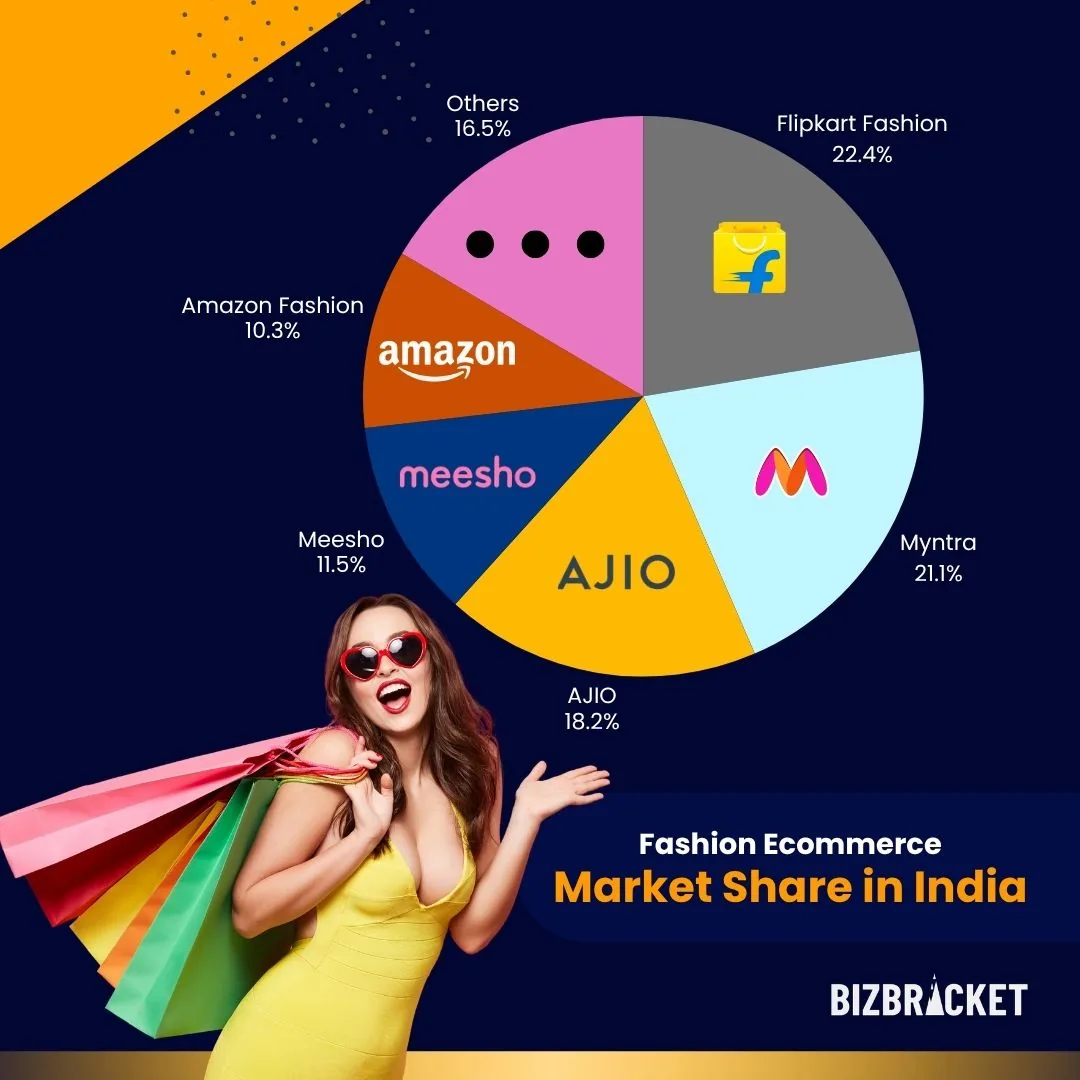
Recent banking and market research data for the 2025-2026 period reveals that the Flipkart Group, which acquired Myntra in 2014, commands a dominant 43.5% share of the Indian online fashion market.
When broken down individually, Flipkart Fashion leads with 22.4%, closely followed by Myntra at 21.1%. Direct fashion-first rivals like AJIO hold 18.2%, while low-cost competitors like Meesho command 11.5%, and Amazon Fashion accounts for 10.3%, with the remaining 16.5% distributed among other smaller platforms.
Despite the aggressive customer acquisition strategies employed by global horizontal marketplaces and deep-pocketed conglomerates, the specialized fashion-first positioning of Myntra has allowed it to retain a loyal customer cohort that prioritizes trend curation over generic discounting.
Conclusion
The journey of Myntra shows how a company can grow by making bold changes at the right time. From starting as a gifting platform to becoming one of India’s biggest fashion marketplaces, Myntra has built its success on strong brand partnerships, private labels, sale events, and strict seller controls.
Its mix of online and offline presence, along with focus on customer trust, has helped it stay ahead in a crowded market. As fashion e commerce in India continues to expand, the Myntra business model stands as a prime example of how clear strategy, technology, and customer focus can turn a startup into a market leader.