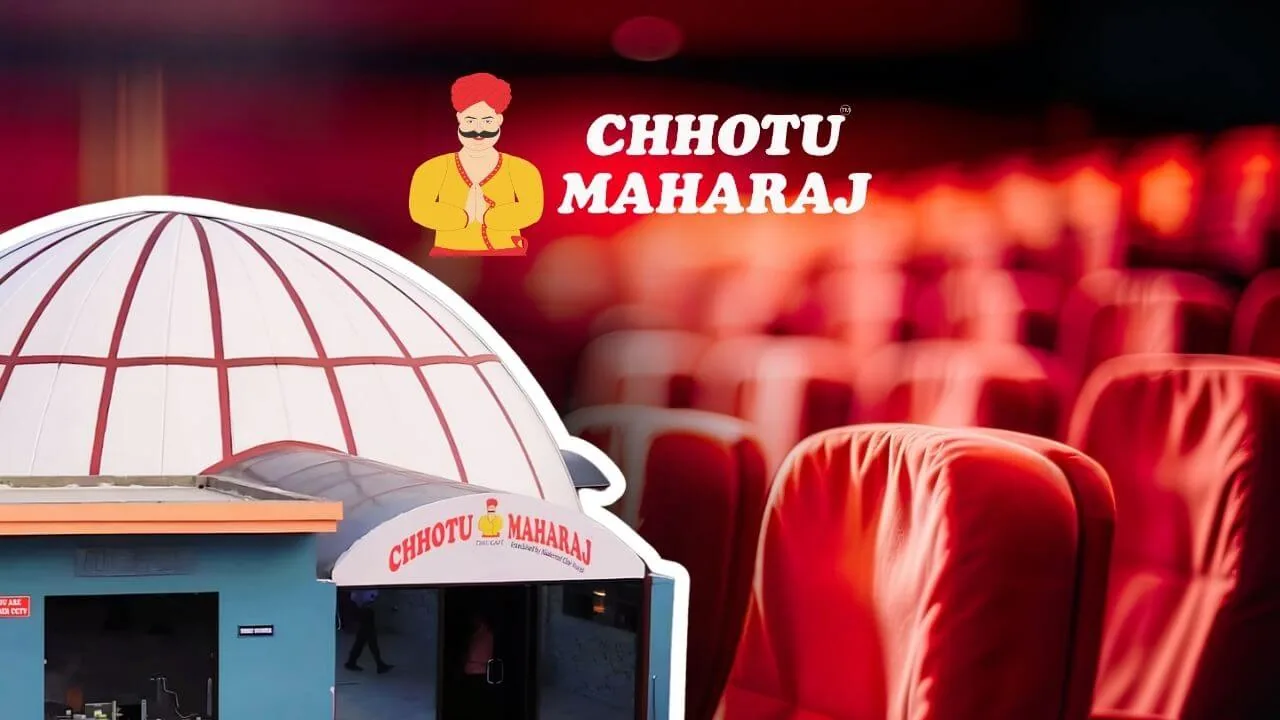
Multiplex chains like PVR INOX, Cinepolis and others have long dominated the shopping malls in metro cities, where watching a movie with popcorn has become part of the routine. But outside the metros, smaller and mid-sized cities have moved ahead with a different idea. That idea is Chhotu Maharaj Cine Café, a model that combines a cinema and a restaurant under one roof.
It would be fair to say that shopping malls and multiplexes now feel old, while Chhotu Maharaj Cinema and Cafe brings in a fresh model. From here, the story moves to how the company built its business model, created multiple revenue streams, and planned its expansion across India.
Chhotu Maharaj Concept
Chhotu Maharaj launched in 2018 by the BSE-listed entertainment company K Sera Sera (KSS) Group—renowned for Bollywood hits like Sarkar, Partner, and Golmaal—the concept was designed to bridge the infrastructure gap in Tier-2, Tier-3, and rural markets. These regions lacked shopping malls and multiplexes but showed rising demand for organized dining and digital entertainment. After its initial rollout, the franchise network accelerated between 2021 and 2026, expanding across multiple states and steadily reshaping the cinema landscape.
Building a traditional cinema usually takes a lot of money and months of construction work. To avoid these burdens, the company designed a Company Owned, Franchise Operated (COFO) model. For each outlet, about 3,500 to 5,000 square feet of open land, a terrace, or a hotel rooftop is needed. Instead of brick-and-mortar buildings, the setup uses pre-fabricated domes made of fire-resistant and waterproof composite fiber.
Plug-and-Play Setup
"The use of advanced composite materials allows the entire air-conditioned dome setup to be fully operational within seven to ten days," a senior operations executive from K Sera Sera Group stated. "This low-gestation mechanism completely alters the economics of film exhibition in regional markets."
The initial dome-shaped facility featuring a double-curved screen was established in Patna, Bihar. Subsequently, the footprint extended to Uttar Pradesh (including Varanasi, Moradabad, Agra, Etawah, Amroha, and Fatehpur), Madhya Pradesh (Indore, Ujjain, and Rewa), Uttarakhand (Rishikesh and Haridwar), alongside operational units in Maharashtra, Haryana, Jharkhand, and Odisha.
Business Model
Unlike standard multiplexes that rely heavily on box office collections and high-margin food court partnerships, the Cine Café model operates on a hybrid revenue architecture. Each mini-theatre is capped at a seating capacity of 100 to 150 seats, utilizing recliners and sofas arranged with significant interpersonal spacing. Standard operations follow traditional theatrical windows, screening new Bollywood and regional releases from Friday onward on fixed daily schedules.
However, the lower seat count permits an alternative monetization channel through private bookings. The entire dome can be reserved by families or corporate groups for private events, birthday parties, or social gatherings. During these slots, patrons are permitted to stream custom content or older films.
Financially, the model insulates franchisees from sole dependence on ticket sales. Earnings are distributed across box office receipts, standard restaurant dining, home delivery services, event rentals, and local on-screen advertising.
Internal financial projections indicate that a conservative 30% occupancy rate yields a net monthly profit of Rs 4–5 lakh after accounting for operational expenses. When occupancy crosses the 50% threshold, net monthly returns are estimated to exceed Rs 10 lakh. This revenue mix reduces the capital recovery timeline to approximately 15 to 20 months.
Mass Pricing Strategy
The long-term expansion blueprint outlined by K Sera Sera involves scaling the network to 9,000 outlets across India, utilizing 360-degree visual projection technologies. To ensure sustained footfalls in semi-urban and rural areas, a volume-driven pricing strategy has been implemented.
Ticket pricing structures are tiered into three segments: Prime tickets are pegged at Rs 110, Gold at Rs 130, and Platinum seats at Rs 150. This deliberate low-cost pricing keeps film viewing accessible to rural audiences while driving auxiliary food and beverage consumption at the attached café.
Decentralized Model
The growth of this dome-theatre network highlights a broader shift in India's consumption patterns. Much like how e-commerce platforms like Meesho scaled by prioritizing deep rural penetration over urban premium segments, regional entertainment consumption is no longer waiting for metro-centric mall developments to arrive.
By creating a self-contained, low-overhead economic ecosystem, semi-urban centers are developing native entertainment infrastructure. This decentralized approach effectively unlocks a massive, previously untapped consumer base that larger multiplex chains cannot financially afford to service under their current cost structures.