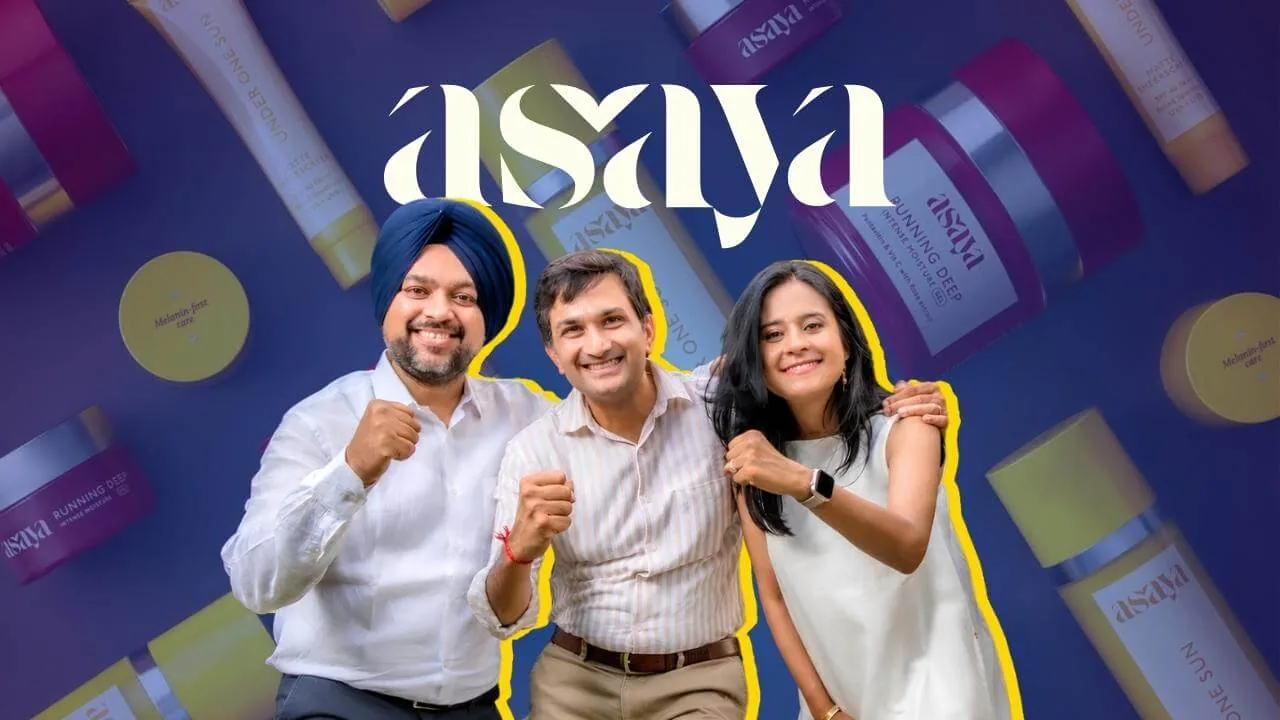
Bengaluru-based skincare startup Asaya has raised Rs 88 crore in a Series A funding round at a valuation of Rs 400 crore. The company focuses on science-led skincare products designed for melanin-rich skin.
Fresh funding comes as Asaya looks to expand its product range, invest more in research and development and reach more customers across India. The startup also says it is now operating at an annual recurring revenue, or ARR, run rate of Rs 100 crore.
Series A round includes investments from RPSG Capital, OTP Ventures, Huddle Ventures, Hyperscale Ventures and 72 Ventures. Several prominent investors participated through these funds, including Abhishek Goenka, Sambit Dash, Suhail Sameer, Kunal Suri, Saurabh Vashishtha, Ishaan Khosla, Sanil Sachar, Suyash Saraf, Anisha Saraf, Sanjay Nayar and Falguni Nayar.

Asaya says the funding will support three main areas: research and development, new products and expansion across locations and sales channels. Nearly one-fifth of the fresh capital is planned for R&D, while the remaining amount will support product development and wider market expansion.
Asaya Targets Rs 200 Crore
The startup says it is currently operating at a Rs 100 crore ARR run rate and aims to reach Rs 200 crore within the next 18 months. Co-founder Neeraj Biyani said the business is now contribution-level profitable and described the latest funding as confirmation that the company is moving in the right direction.
D2C skincare brand Asaya, was co-founded by Neeraj Biyani, Eeti Sharma and Mandeep Bhatia. The founders are building the company around the idea that skincare for melanin-rich skin requires stronger scientific research rather than simply better marketing.
A key part of Asaya product development is MelaMe, a proprietary and patent-pending complex. The company says clinical testing shows that the ingredient complex can reduce hyperpigmentation in 14 days.
The brand offers products covering different stages of a hyperpigmentation-focused skincare routine. Its portfolio includes cleansers, serums, spot treatments, moisturisers and sunscreens.
Investors Perspective
RPSG Capital Managing Partner Abhishek Goenka said the market has long recognised that melanin-rich skin is underserved, but the industry has often focused more on marketing than science. He said MelaMe represents Asaya’s attempt to address the problem through research and clinical studies.
Asaya is also widening its distribution network. The brand is expanding into quick-commerce platforms and is exploring partnerships with offline retailers. This gives the startup access to customers who prefer faster delivery or physical stores instead of buying only through brand websites.

Through its own website, Asaya has expanded its serviceable network to more than 18,000 PIN codes. More than 2,000 PIN codes currently receive deliveries within 24 hours, according to the company.
About Asaya
Asaya is a science-first skincare brand based in Bengaluru that focuses on the needs of melanin-rich skin. Its product strategy centres on pigmentation, skin health and clinically backed formulations.
Company is also preparing for a significant hiring push. It plans to nearly double its team in the coming months as it expands its product portfolio, distribution network and operations.
Management says research will remain an important part of its next growth phase. Apart from expanding MelaMe-based products, Asaya plans to develop a second proprietary solution aimed at addressing consumer skincare concerns.
Latest funding therefore comes at a stage when the brand is moving beyond its initial product-market push. With higher spending on R&D, wider distribution and a larger team, Asaya is positioning itself to compete in India’s growing premium skincare market.
The combination of a Rs 400 crore valuation, Rs 100 crore ARR run rate and a target of Rs 200 crore ARR in 18 months gives investors a clear growth benchmark. The company’s ability to maintain product quality while scaling across quick commerce, online and offline channels will be important to its next phase.