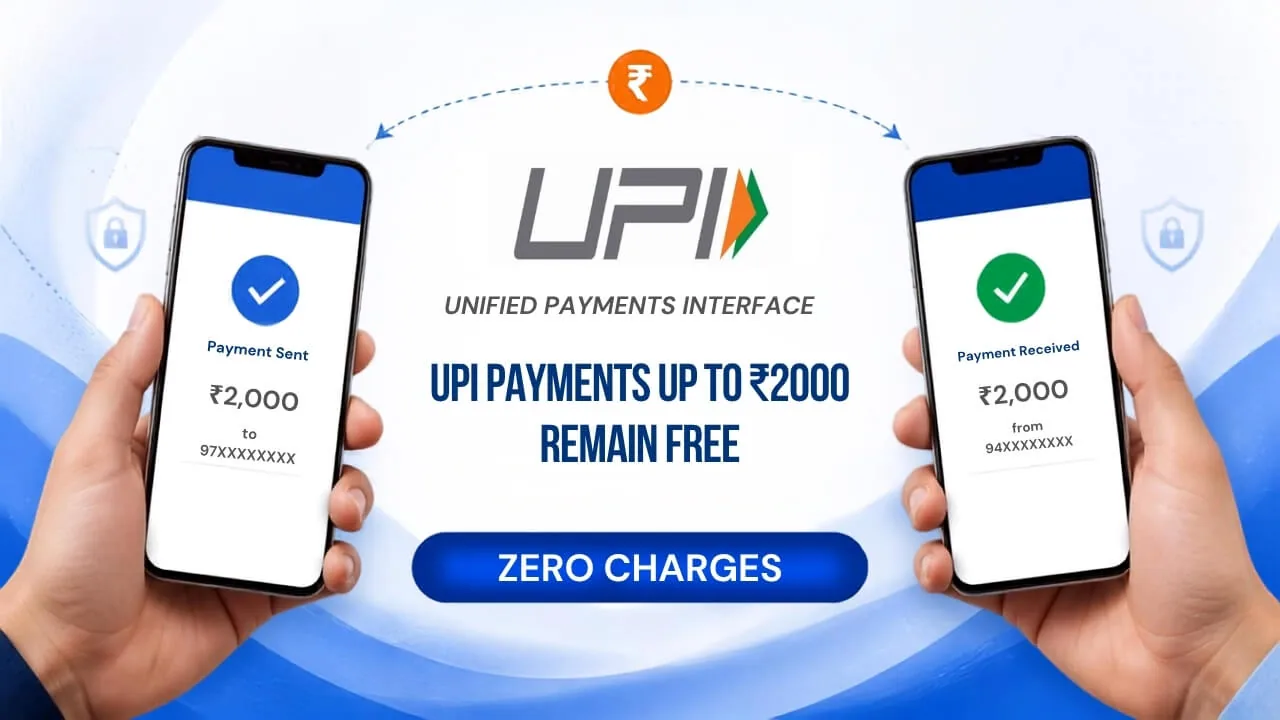
The government has clarified that UPI payments are free and that banks and payment system providers cannot levy charges on UPI transactions of up to Rs 2,000. The clarification comes after recent changes to payment rules triggered questions over whether users could eventually be charged for using UPI.
Finance Ministry has issued a gazette notification under the Payment and Settlement Systems Act, specifying the treatment of UPI transactions and RuPay-powered debit card payments within the Rs 2,000 limit.
Under the notification, no bank or system provider can impose a direct or indirect charge on a person making or receiving payments through the specified electronic modes. This means the customer making a qualifying UPI payment cannot be asked to pay an additional transaction fee.
UPI Payments Stay Free
The notification specifically includes UPI payments up to Rs 2,000 and payments made through RuPay-powered debit cards within the category of “electronic modes of payment”. The clarification is aimed at removing uncertainty around charges following amendments to the Payment and Settlement Systems Act, 2007.
For ordinary users, the key point is that the payment itself remains free within the specified UPI limit. There is no separate bank charge that can be added to a qualifying transaction simply because the customer is using UPI.
The government had also clarified last month that consumers would not be charged for making payments through UPI. It said any future merchant discount rate, or MDR, would apply only to selected transactions above a specified threshold rather than becoming a general charge on all UPI payments.
MDR Rules Clarification
MDR is a fee associated with certain digital card and payment transactions and is generally paid within the merchant payment ecosystem rather than being directly charged to a consumer. The government has said there will be no blanket MDR on merchants for UPI transactions.
It has also said person-to-person, or P2P, UPI payments will continue to remain free. These are transactions where one individual transfers money directly to another person through UPI.
For merchant transactions where charges may eventually apply under specified rules, the government has indicated that the rates would be significantly lower than those applicable to debit or credit card payments. This distinction is important because UPI is used for both personal transfers and purchases from businesses.
UPI Payment Charges
There is currently no general consumer charge for making regular UPI payments from a bank account. P2P UPI transfers remain free, while merchant payments through UPI are also not subject to a blanket MDR. The latest notification specifically protects UPI transactions up to Rs 2,000 from direct or indirect charges.
The charge structure should therefore not be understood as a simple slab where users pay more for every larger UPI payment. Instead, any future MDR framework would depend on the type and value of the transaction and the applicable rules. The government has indicated that selected transactions above a specified threshold could come under MDR, while consumers would not be charged directly.
UPI Payment Concerns
The clarification follows debate around a recent amendment to the Payment and Settlement Systems Act. Some concerns had emerged that changes to the law could eventually result in charges being imposed on people using UPI for everyday payments.
The latest notification seeks to clarify the position by specifically identifying UPI transactions up to Rs 2,000 and RuPay-powered debit card transactions as electronic modes for which charges cannot be imposed on the person making or receiving the payment.
This is particularly relevant because UPI has become a widely used payment method for small-value purchases and personal transfers. Keeping such transactions free remains important for consumers who use digital payments for everyday expenses.
UPI Transaction Fee
The government position also separates consumer charges from possible charges within the merchant payment system. A future MDR, where permitted for selected transactions, would not automatically mean that a customer has to pay a UPI transaction fee.
For users, the immediate takeaway is that qualifying UPI payments up to Rs 2,000 remain protected from bank and system-provider charges. P2P payments also continue to remain free, while there is no blanket MDR applicable to merchants.
Fresh clarification comes as the government works to define the payment ecosystem around UPI while keeping digital transactions accessible. Any future changes to merchant-level charges would depend on the specified thresholds and rules notified for such transactions.