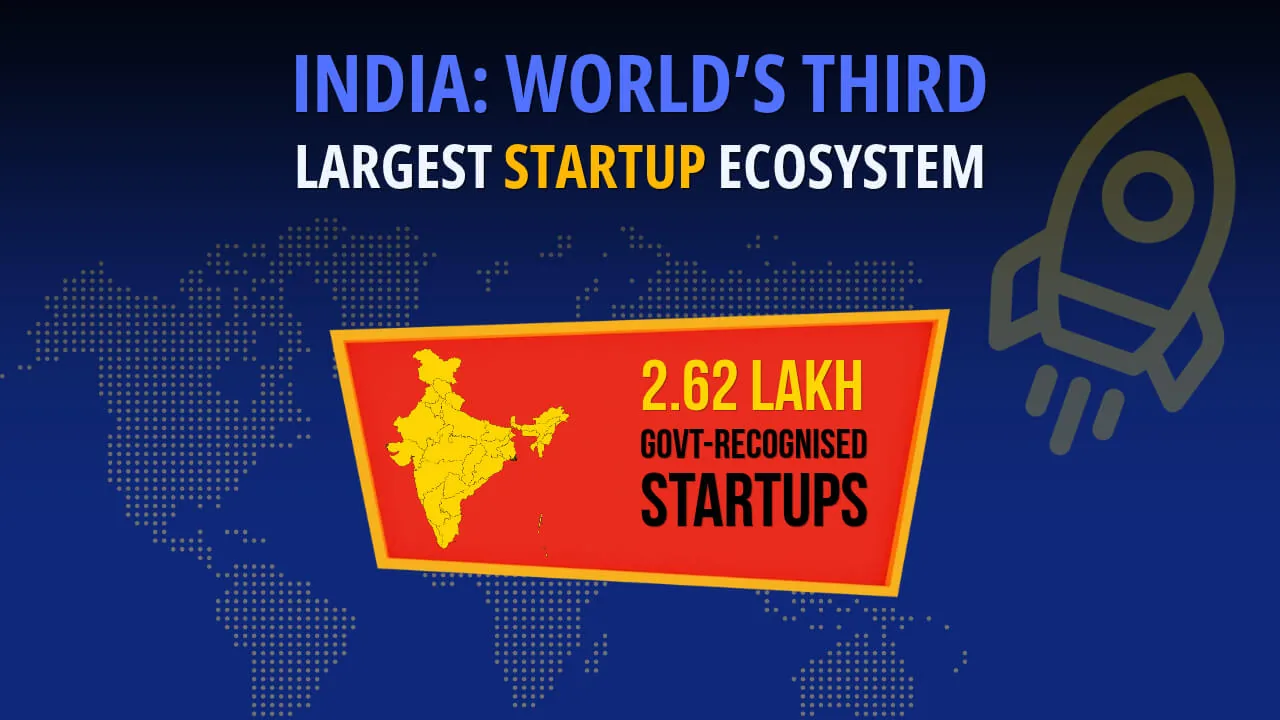
India has emerged as the world’s third-largest startup ecosystem, with more than 2.62 lakh government-recognised startups creating over 25 lakh jobs across the country. This milestone highlights the growing role of entrepreneurship in employment generation, business development and opportunities for young people, according to an official statement.
Announcement coincided with National Entrepreneurship Day, observed on November 9. The government said the increasing number of startups reflects a gradual shift from job seekers to job creators, with new businesses emerging across different sectors and regions.
During FY26, the government recognised more than 55,200 startups, the highest number recorded in a single financial year since the launch of the Startup India initiative in 2016. This represented a 51.6% increase over the number of startups recognised in FY25.
Startup Numbers Rise
The growth in recognised startups has also contributed to employment generation. According to the government, startups had created more than 25 lakh direct jobs up to October 2026.
Direct employment generated by startups increased 36.1% in FY26 compared with FY25. The rise indicates that the expansion of new businesses is contributing to job opportunities beyond traditional large companies and established industries.
The government said startups are now present across all states and Union Territories. Maharashtra, Karnataka, Uttar Pradesh, Delhi and Gujarat have emerged as leading regions in terms of recognised startups and direct employment generation, based on figures recorded as of March 31, 2026.
Women Participation
Women participation in the startup ecosystem has also increased. More than 1.07 lakh government-recognised startups had at least one-woman director or partner as of March 2026.
These businesses account for around 48% of the total recognised startup base, according to the government statement. The figure includes startups with at least one woman in a director or partner position and does not necessarily represent businesses founded or entirely owned by women.
The growing presence of women in startup leadership reflects a wider expansion of participation in entrepreneurship. However, access to funding, business networks, market opportunities and leadership roles remains important for sustaining this growth.
Govt Supports Entrepreneurs
The government has introduced several programmes to support new businesses through funding, mentorship, innovation and enterprise development. These include Startup India, the Fund of Funds for Startups, the Credit Guarantee Scheme for Startups (CGSS) and the Startup India Seed Fund Scheme (SISFS).
Other initiatives, such as the Atal Innovation Mission and the Prime Minister Employment Generation Programme (PMEGP), are aimed at encouraging innovation, supporting early-stage businesses and creating self-employment opportunities.
The government said these programmes are helping entrepreneurs access financial support, business guidance and digital platforms. Such support is particularly relevant for startups operating outside major business centres, where access to investors and established networks can be limited.
Nearly half of the recognised startups originate from Tier-II and Tier-III cities, according to the statement. The growth of businesses in smaller cities and rural areas indicates that startup activity is gradually spreading beyond traditional technology and business hubs.
Indian Startup Ecosystem
India startup ecosystem has expanded significantly since the launch of Startup India in January 2016. The initiative was introduced to encourage new businesses, improve the ease of starting and operating companies, and support innovation through policy measures and institutional assistance.
The country has a large young population, with nearly 65% of people below the age of 35, according to the government statement. This demographic provides a large potential workforce as well as a base of consumers and future entrepreneurs. The increase to more than 2.62 lakh recognised startups represents a major milestone in the development of this ecosystem.
National Entrepreneurship Day is observed on November 9, the date on which the Ministry of Skill Development and Entrepreneurship was established in 2014. The ministry focuses on skill development, vocational training and entrepreneurship promotion as part of the wider employment agenda.
Startups in Smaller Cities
The expansion of startups in smaller cities is another feature of the latest figures. Businesses are increasingly emerging from locations beyond major metropolitan centres, supported by digital services, online markets and government-backed entrepreneurship programmes.
For young people in Tier-II and Tier-III cities, starting a business can provide an alternative to seeking employment in larger urban centres. Rural entrepreneurship is also receiving attention through programmes focused on self-employment and small enterprise development.
However, the number of recognised startups alone does not indicate how many businesses remain operational, achieve long-term growth or become profitable. Their ability to secure funding, reach customers and generate stable employment will remain important measures of the sector performance.
The latest figures underline the expansion of entrepreneurship in India, but sustaining this growth will require continued access to finance, skilled workers, infrastructure and markets. The next stage will depend on how effectively new businesses convert their early growth into stable operations and long-term employment.