
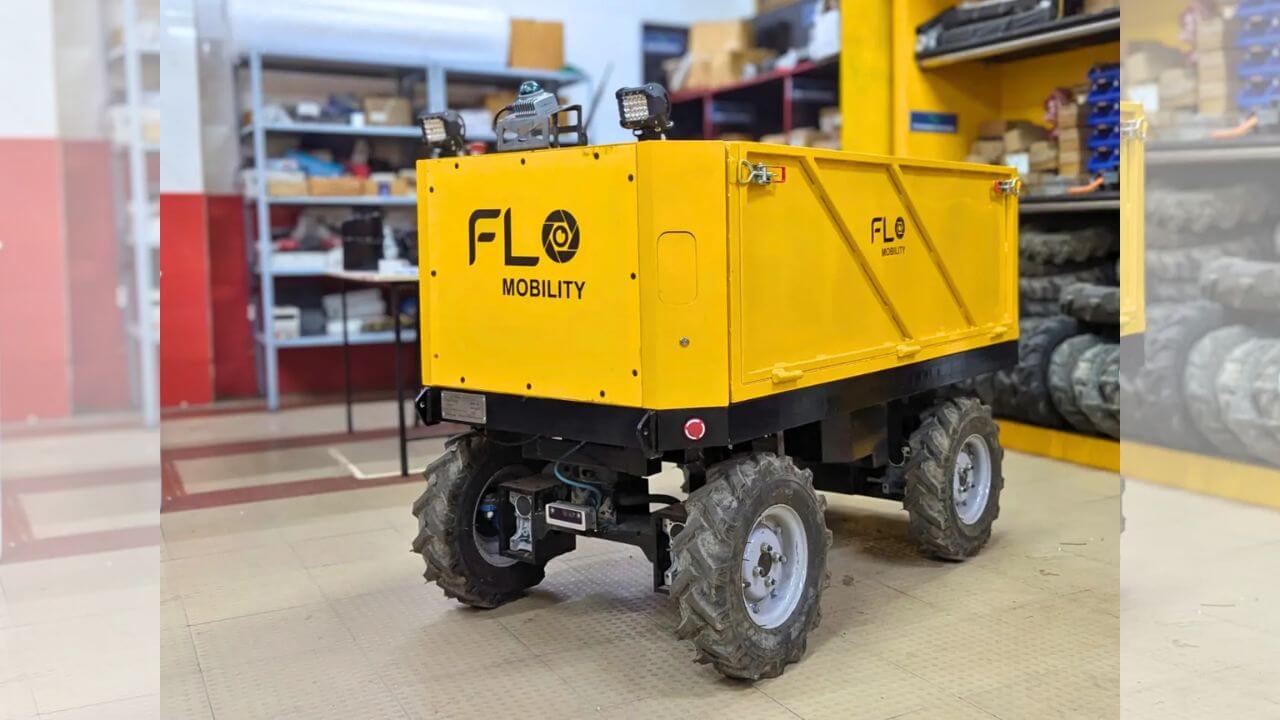
Flo Mobility, a startup specializing in physical AI for the construction sector, has raised $2.5 million in a pre-Series A funding round. The investment was co-led by Mela Ventures and Arali Ventures, marking a significant push toward deploying autonomous systems in an industry traditionally reliant on manual labor.
The company plans to utilize the fresh capital to scale its manufacturing capabilities and refine its proprietary autonomy stack. Beyond domestic growth, a portion of the funds is earmarked for a strategic entry into international markets, with a primary focus on the Middle East, where large-scale infrastructure projects are increasingly seeking technical intervention to manage high costs.
Heavy Lifting Automation
At the heart of Flo Mobility’s operations is the ‘Flo Hauler’—a battery-powered autonomous robot engineered to navigate the chaotic and often unpredictable environment of a construction site. Unlike factory floors, which are controlled and mapped, construction sites present "unstructured" challenges: uneven mud tracks, shifting debris, and multi-floor layouts.
The Flo Hauler is built to manage these variables, carrying loads of up to 1.5 tonnes. By automating the transport of heavy materials, the startup addresses a specific "cash leak" in project management—the inefficiency of using skilled workers for repetitive, low-skill haulage.
The startup’s track record includes the deployment of over 60 robots across 10 Indian states. These machines are currently active on sites managed by industry giants, including L&T, Godrej Properties, Embassy Group, Sobha, and Capacite Infra.
The data gathered from these deployments suggests a stark improvement in site economics. According to company records, developers using these autonomous haulers reported a 45% reduction in costs related to material movement. Furthermore, the speed of logistics on-site increased by 50%. Perhaps most critically for the high-risk construction sector, Flo Mobility claims its systems helped achieve a 67% drop in workplace accidents.
Our robots do not replace the skilled labour that builds India’s cities; they free that labour to do the work that matters.— Manesh Jain, Co-founder, Flo Mobility
“The construction industry has been operating the same way for decades, with enormous amounts of labour dedicated to simply moving materials from one place to another,” noted Manesh Jain, co-founder of Flo Mobility.
Focus on ROI
The investment comes at a time when venture capital is increasingly flowing toward "Physical AI"—software that interacts with the real world through hardware. For investors, the appeal lies in the immediate financial return for the end-user.
Viju George, partner at Mela Ventures, emphasized that the sector is no longer looking for experimental tech but for tools that fix the bottom line. “The construction sector requires purpose-built solutions that deliver ROI in months, not years. Manesh and Pratik have demonstrated deep domain understanding and technical depth, exactly what's needed to deploy autonomy in unstructured environments,” George said.
Skilled Labor
A recurring concern with robotics is the potential displacement of workers. However, the leadership at Flo Mobility views their robots as a tool for optimization rather than a replacement for the workforce. The steep climb in project complexity in India’s urban centers requires more hands-on masonry, electrical, and structural work, which is often delayed by logistics bottlenecks.
As Flo Mobility prepares for its Middle Eastern expansion, the focus remains on the "mettle" of its hardware. Operating in harsh weather conditions and sandy terrains will be the next test for the Bengaluru-born startup. If successful, the move could position an Indian robotics firm at the center of global infrastructure development, proving that autonomous tech can handle the dirt and dust of a real-world site just as well as a clean-room lab.