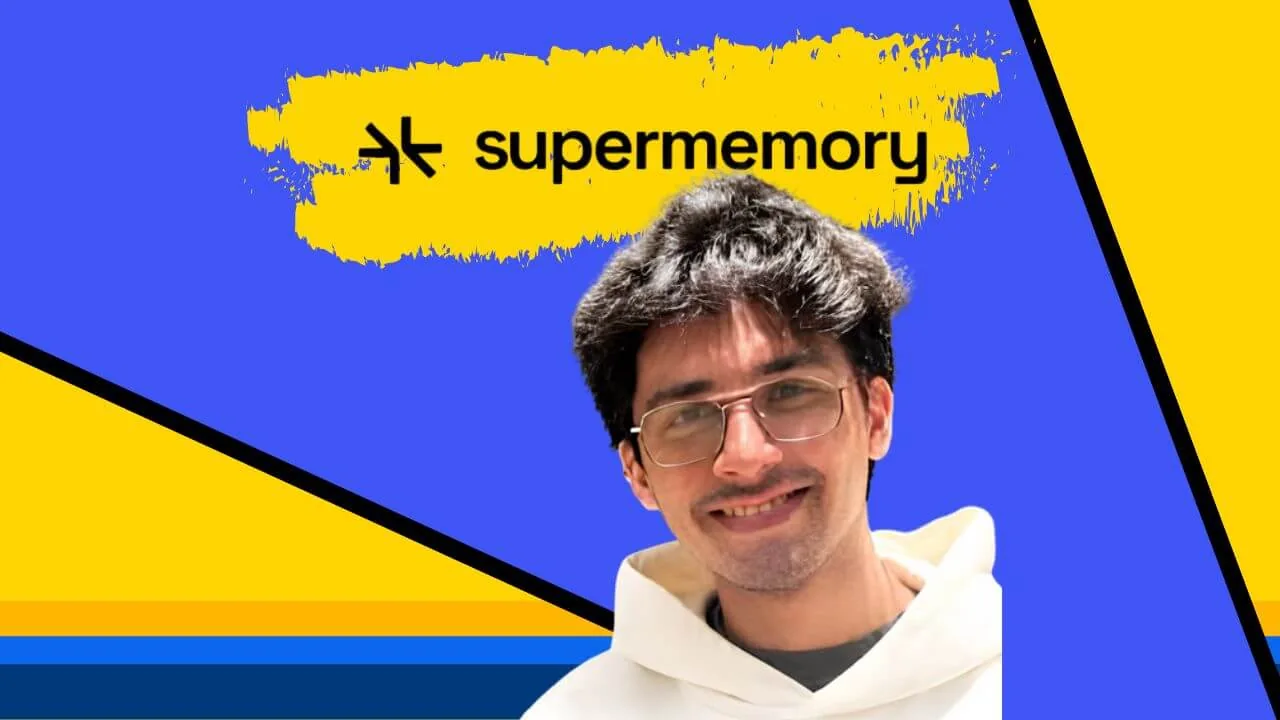
While most engineering students are busy tracking college admissions and campus placements, a 19-year-old Dhravya Shah decided to drop out of his BTech course from IIT Bombay to build a multi-million-dollar startup, Supermemory.
The Mumbai teenager walked away from a IIT degree to launch an artificial intelligence startup that has now raised $3 million in seed funding. His venture has caught the attention of global tech investors, with backing coming from individuals linked to Google, OpenAI, and Cloudflare.
Shah began working on AI tools while preparing for the IIT entrance examination. According to the information available about his journey, one of his early projects generated enough income to help fund his move to the United States.
His path later took him away from the conventional engineering and placement route. Reports about his journey say he left an IIT Bombay BTech programme to focus on building products. The decision came as he was already experimenting with software and AI projects.
AI New Ideas
After moving to the US, Shah set himself a target of building and launching one product every week for 40 consecutive weeks. The exercise was aimed at testing different ideas rather than spending a long period developing a single product before getting user feedback.
The approach allowed him to make smaller experiments and assess which products attracted interest. Supermemory eventually emerged from this process and became the project that developed into a funded startup.
Shah also obtained an O-1 visa in the US. The visa is issued to individuals who can demonstrate extraordinary ability in fields including technology, science, business or the arts. The grant itself does not indicate the commercial success of a company, but forms part of Shah professional journey in the US.
Builds AI Memory
Supermemory is designed to give AI applications a way to retain and retrieve information from previous interactions. The system can work with sources such as emails, files, chats, PDFs and other documents.
The basic problem it addresses is that many AI applications do not automatically retain useful information across separate interactions. A memory layer can allow an application to use information collected earlier when handling later requests.
This has applications for AI products that need to work with a users documents or ongoing conversations. However, the usefulness of such systems will depend on factors such as accuracy, privacy, data handling and how well they fit into existing software.
Startup $3M Funding
Supermemory has raised $3 million from investors associated with major technology companies, including Google, OpenAI and Cloudflare. The funding gives the startup capital to continue developing its product and expanding its work in AI memory.
The investment also places the company in a crowded AI market where several startups are developing infrastructure and tools around large language models. Funding alone does not establish long-term demand, and Supermemory will need to convert its technology into sustained use by developers or businesses.
The company has emerged from a period in which Shah focused on launching multiple products and testing them with users. That product-building approach is central to the account of how Supermemory developed.
What is Supermemory
Supermemory is an AI infrastructure startup focused on memory for artificial intelligence applications. It is associated with founder Dhravya Shah and is built around technology that allows AI systems to store, organise and retrieve information from different sources.
The startup works as a software layer that can connect information such as documents, emails, chats and other data to AI applications. Its business model is based on providing this memory capability to developers and AI products rather than operating as a conventional consumer content platform.
Supermemory grew out of Shah’s product experiments after he moved to the US. The company has since attracted funding from technology-focused investors and people associated with major firms in the AI and cloud technology sector.
GenZ Founders Risk
Shah story is also part of a wider discussion around GenZ founders choosing entrepreneurship before completing conventional higher education. His reported decision to leave an IIT Bombay programme stands out because most students entering such institutions typically pursue engineering degrees and campus placements.
That route, however, is not necessarily transferable to other students. Building a startup involves financial and professional risks, and early funding does not guarantee that a product will become a sustainable business.
For Supermemory, the next stage will depend less on the novelty of its founder story and more on whether developers and businesses continue to use its AI memory technology. The $3 million funding provides room for further development, but the company will ultimately have to establish demand in a fast-changing AI market.