

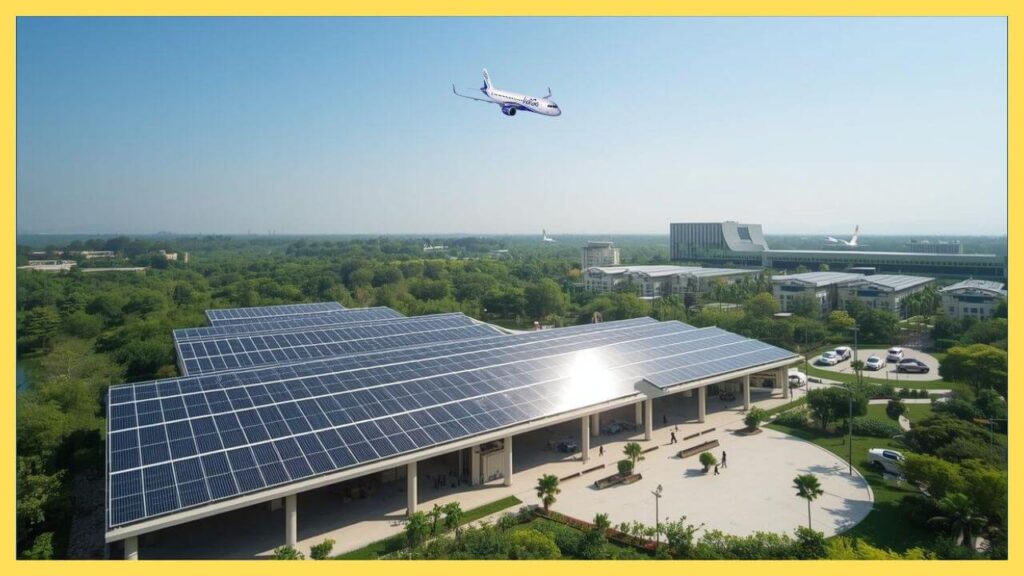
India has significantly expanded the use of renewable energy in aviation infrastructure, with 93 airports now operating on 100 per cent green energy. This information was shared in Parliament by Minister of State for Civil Aviation Murlidhar Mohol through a written response in the Lok Sabha.
Greeen Airports in India
The minister said the shift forms part of broader efforts to reduce the aviation sector’s environmental impact while supporting long-term growth in air connectivity. Renewable power sources used by airports include solar and wind energy, either generated on-site or sourced through green power procurement arrangements.
Alongside energy transition, carbon management has also seen progress. Four major airports—Delhi, Mumbai, Hyderabad, and Bengaluru—have reached Level 5 accreditation under the Airports Council International carbon accreditation programme, the highest level that recognises full carbon neutrality.
Carbon Goals Advance
The accreditation reflects efforts to measure, manage, and offset carbon emissions across airport operations. According to the ministry, these measures align Indian airports with global sustainability benchmarks followed by leading international hubs.
In parallel, the government has outlined clear targets for blending sustainable aviation fuel with conventional jet fuel. Indicative blending levels have been approved at 1 per cent by 2027, 2 per cent by 2028, and 5 per cent by 2030, initially applicable to international flights.
The introduction of SAF is expected to lower lifecycle emissions from aviation fuel while encouraging domestic production and supply chains for cleaner alternatives. Officials have indicated that the targets may be reviewed as technology and availability improve.
Greenfield Airport Policy
The ministry has also framed a Greenfield Airport Policy to guide the development of new airports across the country. Under this policy, project proponents, including state governments and private entities, must submit proposals to the Ministry of Civil Aviation for evaluation.
These proposals are examined in consultation with multiple departments and the concerned state governments before approvals are granted. The process aims to balance regional development needs with environmental, safety, and economic considerations.
According to the minister, greenfield airport development is viewed as a strategic tool to support the national vision of inclusive growth and improved regional connectivity under the Viksit Bharat framework.
Regional Growth Focus
New airports are expected to play a key role in linking remote and underserved regions with national and global markets. Improved air connectivity is projected to boost tourism, trade, and logistics while generating employment opportunities at the local level.
Large projects such as the Navi Mumbai International Airport are expected to influence surrounding regions by enabling industrial corridors, logistics hubs, and urban development. Improved infrastructure is seen as a catalyst for attracting private investment and supporting balanced urban expansion.
The government has positioned airport development as part of a wider infrastructure push that integrates transport, industry, and regional planning.
Manufacturing Push Continues
Beyond airport operations, the Centre is also promoting an aircraft manufacturing and maintenance ecosystem under the Make in India initiative. This includes support for regional transport aircraft, components, and associated equipment.
Several policy measures have been introduced to encourage this ecosystem. These include GST rate rationalisation, removal of certain royalties, amendments to visa rules for foreign pilots and crew involved in maintenance, repair and overhaul services, and extended timelines for export and reimport of aircraft parts under repair.
Together, these initiatives signal a coordinated approach to making India’s aviation sector more sustainable, self-reliant, and globally competitive, while addressing environmental goals alongside infrastructure and industrial growth.